Mahadasha, Antardasha and Pratyantardasha: A Beginner’s Guide
Dashas are nested planetary chapters. Learning the hierarchy—from the long Mahadasha to the shorter Pratyantardasha—makes timing easier to understand without treating life like a fixed timetable.
A calendar made of planetary periods
A dasha is a period ruled by a planet. Several dasha systems exist; Vimshottari is the one most people mean. It distributes a 120-year theoretical cycle among Ketu, Venus, Sun, Moon, Mars, Rahu, Jupiter, Saturn and Mercury in that fixed order.
The starting ruler is determined by the nakshatra occupied by the Moon at birth. The Moon’s progress through that nakshatra determines how much of the first period remains. This is why an accurate birth time and a clearly stated ayanamsha matter.
- Ketu 7 years · Venus 20 · Sun 6 · Moon 10 · Mars 7
- Rahu 18 · Jupiter 16 · Saturn 19 · Mercury 17
Three levels of the timeline
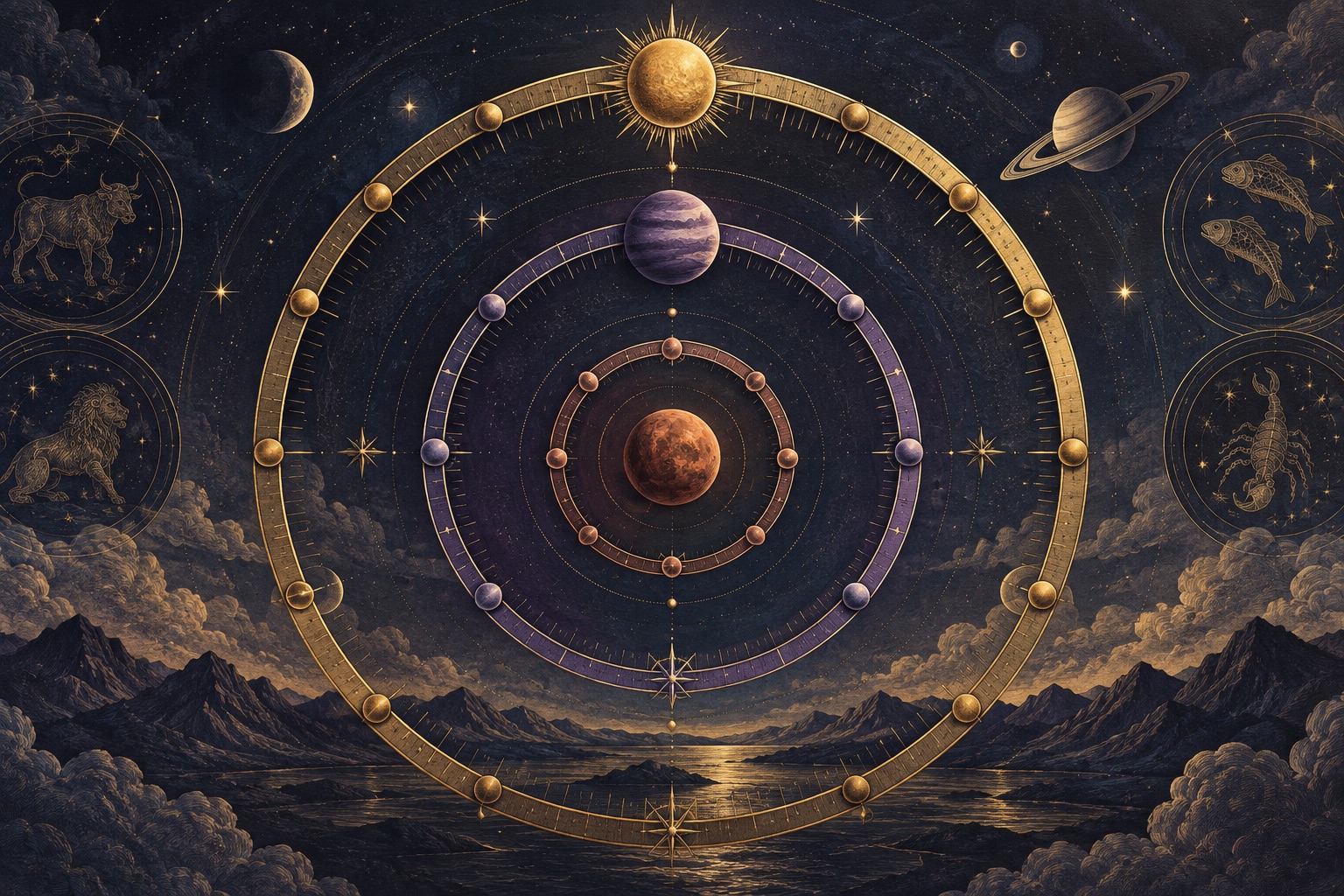
The Mahadasha is the broad chapter: it may last six to twenty years. Every Mahadasha contains nine Antardashas, or sub-periods, apportioned in the same planetary sequence. Each Antardasha contains nine Pratyantardashas, producing a still finer rhythm.
Imagine living through a Saturn Mahadasha, Venus Antardasha and Mercury Pratyantardasha. Saturn sets the long-term terrain; Venus becomes the current storyline; Mercury describes the shorter trigger or emphasis. Interpretation comes from how all three planets function in the natal chart.
Keep in mindOuter ring: Mahadasha · middle ring: Antardasha · inner ring: Pratyantardasha. Smaller periods refine the story; they do not erase the larger one.
How a planet gives results
A period ruler tends to activate the houses it owns, the house it occupies, planets it joins or aspects, and the themes of its natural symbolism. A Venus period is not automatically romance and a Saturn period is not automatically hardship. For one Ascendant, Venus may rule supportive houses; for another, more complicated ones.
Strength and dignity matter, as do yogas and divisional charts. Events are more plausible when several layers repeat the same theme—for example, a period ruler tied to the tenth house while a major transit also activates career factors.
- Natural meaning: what the planet broadly represents
- Functional role: which houses it rules for this Ascendant
- Placement: the house, sign, dignity and connections
- Repetition: whether divisional charts and transits support the theme
An example without fortune-telling
Suppose Mercury rules and occupies houses connected with education and profession, and is reasonably strong. Its Mahadasha could foreground learning, analysis, commerce or communication. During a Moon Antardasha, home or emotional needs may shape those themes. A Mars Pratyantardasha might coincide with a push to act—but whether that means an exam, a move or a new project depends on the full chart and circumstances.
This approach gives a range of relevant themes rather than pretending a date guarantees a single event. It also leaves room for agency: the same period can be used to study, negotiate, build or communicate more skilfully.
How to read your timeline well
Start with Mahadasha and Antardasha. Note their dates, natal roles and repeated life areas. Use Pratyantardasha only when you need a closer view; too many sub-levels can create false precision. Check major transits as supporting context, not as replacements for the dasha.
Keep a dated journal of decisions and developments. Over time, compare patterns rather than isolated days. Dasha work is most useful when it helps you recognise a season of life and respond deliberately—not when it makes you wait passively for a promised event.
Astrology is a traditional interpretive practice, not a scientifically established way to predict events. Use it for reflection—not as a substitute for qualified medical, legal, financial or mental-health advice.